Michele Chiocciolini The Red Heart’s Impulse Against the Dark World
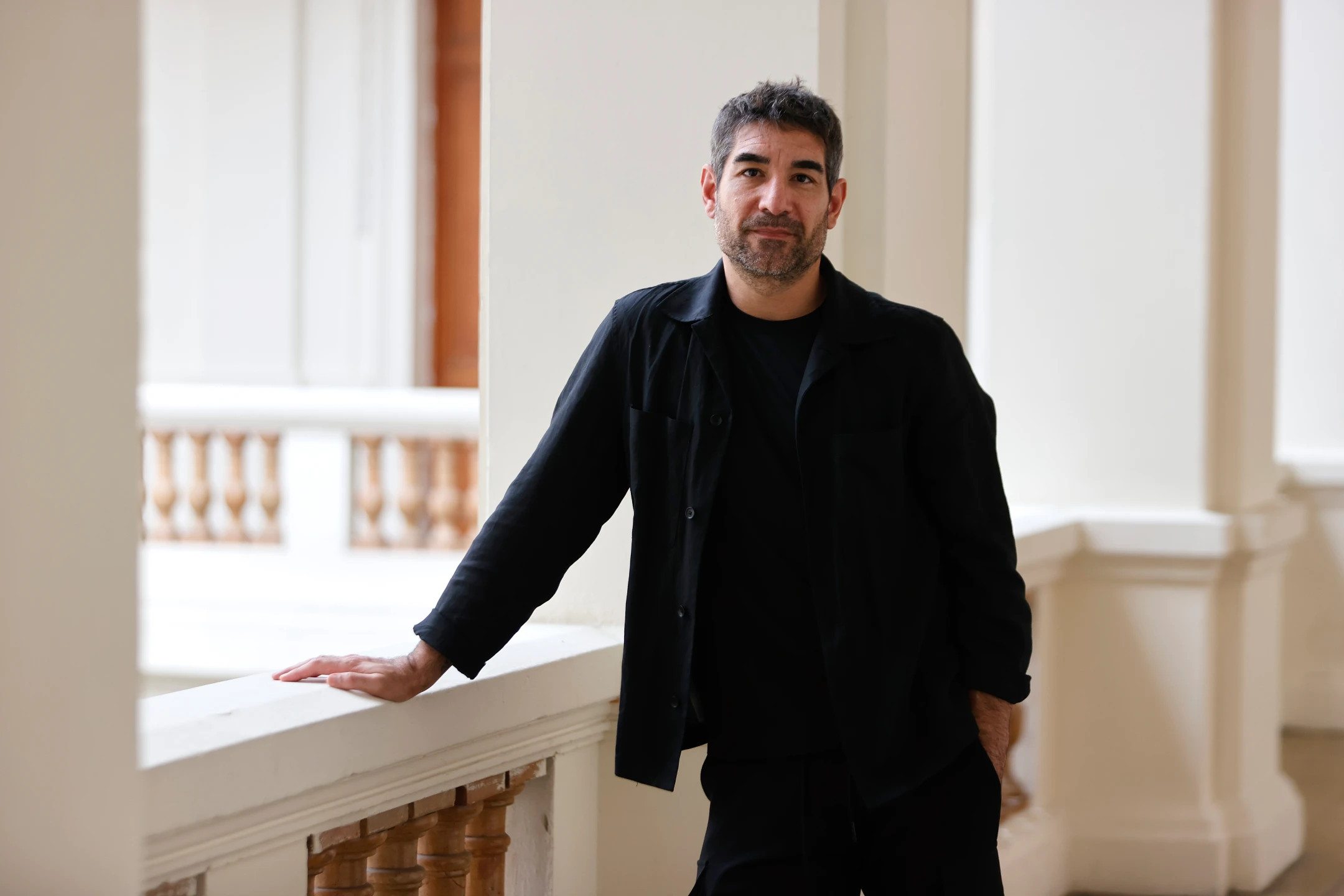
Solimán López is a contemporary artist whose practice operates at the intersection of art, science, technology and ecological transition. His work investigates how information, memory and life can be stored, transmitted and transformed across physical, biological and digital systems, using technology as both a conceptual and technical mediator.
Through the use of environmental DNA, artificial intelligence, data visualization, blockchain, sound and immersive installations, López develops poetic and critical works that make the invisible visible: genetic traces, planetary data, non-human forms of memory and the hidden processes of contemporary technology. His research addresses key issues of our time such as ecological transition, digital sovereignty, biodiversity preservation, posthuman identity and the politics of data, frequently working in collaboration with scientists, laboratories and research centers.
He is recognized for a conceptual, critical and aesthetic use of technology, where technological tools are inseparable from their cultural and ethical implications. He has exhibited in more than 20 countries across Europe, the Americas, the Middle East and Asia, in museums, biennials, fairs, scientific forums and public spaces, including international contexts such as the Brazilian Digital Art Biennial, Ars Electronica, ISEA, and institutions such as the Centre Pompidou, Museo de Arte Contemporáneo de Chile, MAAT Lisbon and the IVAM. He also actively collaborates with scientific forums such as Xpanse, as well as with more than a dozen universities internationally.
CDH Talks: What is art for you in a technologically mediated moment? What is the role of the artist?
Solimán López: I believe that in every period of art history, the most prominent and representative artists, along with those who marked an evolution in thought and in styles, used the technology of their moment as a conceptual catalyst. Applying or using technology is not simply using it as a medium, but understanding it in its full magnitude as an engine of social change, of our perception of reality and of human connections and those tied to our environment and to nature.
Perhaps more than ever we are immersed in a great technological revolution, but I have the impression that it is the same feeling our ancestors had with their own revolutions. Think of the impact of motor vehicles on the horse and carriage industry, on agriculture, on transport. The artist is not a consumer of revolutions but a catalyst of impressions.
We saw it in the avant gardes, in how the industrial revolution inspired a change in the way representation was seen. In how movement in painting was prompted by the moving view from a train carriage window, and by so many other details that great artists have introduced as alternative ways of looking, against mere consumption. Today, more than ever, technology mediates not only the space of industry, but extends into the space of communication, the mediation of the world and the perception of reality. It is now, more than ever, that the analytical figure of the artist and the ecosystem of art must reclaim their critical and analytical position. The artist is a key figure in understanding our own time.
CDH Talks: How have your interests evolved over these 20 years of career?
Solimán López: Like many other artists, I began my artistic path trying to understand myself as an individual. At some point the concepts of identity have touched nearly every artist. After that, and my studies as an art historian, shaped in me an aesthetic and conceptual gaze that, together with the use and analysis of technology, has built this thing I am today. I have always been unsettled by the impacts of human activity and by the wear we produce, consciously and unconsciously, on our environment.
Understanding technological processes and their ambitions became an almost obsessive curiosity that has gradually mediated my evolution and brought my interests into correspondence with the changes of our time. After the launch of the Harddiskmuseum, a digital art museum on a 2TB drive, and later the first museum in art history synthesized in DNA, I began to understand the structures of the digital from the inside, the importance of the intangible and the power of technology as an engine of change.
These analyses reached a critical point with the arrival of COVID, the moment when my work takes on a more reflective and intimate tone, more connected to nature. My project Olea is the first to emerge from this introspection, marking a new line of work where my relationship with the invisible, genetics, the forces of nature, geopolitics, the ecological transition, space colonization and transhumanism are all very present ingredients.
CDH Talks: You work with DNA, blockchain and astronomical data. Can technology be a common language among cultures that share neither language nor history?
Solimán López: Without any wish to align us as individuals, and without speculating about the origins of DNA and its presence throughout the universe, or its longevity that reaches beyond the origins of our own planet, I believe DNA is one of the common links between the analog and the digital, as are quantum physics and the future artificial intelligences endowed with a certain consciousness.
In this sense, technology can become a language of communication and a translator. Soon we will witness inter-species communication and we will be able to learn more deeply where we come from and what the reality of our existence is. That information surely lies in our nearest environment and beyond our visible stars, and the only demonstrable way we have today, besides ancestral knowledge, is the application of technologies.
The beautiful and interesting part of all this is seeing how, at last, we will realize that we are more stupid and small than we think, and that in the end we all belong to the same shared lineage in which there is only one language, consciousness.
CDH Talks: Your latest project, IRIDIA, revolves around the asteroid 16 Psyche. What kind of border are you crossing when an artist lays claim to a celestial body?
Solimán López: The oldest and most absurd of them all. Who does the sky belong to? 16 Psyche is practically pure metal, iron and nickel, and every now and then the headlines say it is worth more than the entire world economy. It is a ridiculous figure and at the same time it says something true about the way we look upward. A gaze completely mediated by capitalism and consumption, where instead of stars we begin to see resources for our activities.
In 2015 the United States passed the SPACE Act, which lets its citizens keep what they extract from a celestial body, while the Outer Space Treaty of 1967 still says that no nation can appropriate anything out there. We are still very "green" in our conception of outer space, and those contradictions are a major source of inspiration for this project. IRIDIA consists of three symbolic, legal, conceptual and artistic acts with one main intention.
To turn the asteroid Psyche 16 into a deep space sculpture. A Spatial Ready-Made, unique in history, which in turn has a direct consequence. The protection of this pure metal from possible extractive activities aimed at recovering its resources. These actions, under the titles ACT I: Declaration, ACT II: Software Obscur and ACT III: Radioflag, are a direct message against the harm we are doing to our planet in service of our limitless economic system. An absurd metaphor that is devouring us as a species. I invite the public to visit the project website www.iridia.world to learn more about these acts.
CDH Talks: In all these years of work, is there a moment that touched you especially? What are the key moments of your career?
Solimán López: The day the laboratory returned to me the first synthetic DNA with a text of mine inside. I had written it on a screen, the way everyone writes, and suddenly there it was, in a tube, turned into a molecule that can be frozen, buried, sent far away. I held it up to the light for a good while. Nothing is visible, of course. It is a transparent liquid.
But knowing that inside it there was a sentence I had thought, and that this sentence could outlive every hard drive, every server, every country I know, left me speechless. It is not an emotion I quite know how to explain. It has something of a funeral and something of a birth.
CDH Talks: How does new media art change the way a culture is perceived from the outside?
Solimán López: When someone thinks of Spain they think of flamenco, of Velázquez, of bullfighting and other clichés associated with our culture and traditions. I come from Burgos, a city with a Gothic cathedral, but with a family life in Córdoba, in the south of Spain, and in other countries such as Bolivia. With roots in Peru (my grandfather was Peruvian). This family syncretism has led me to spend my time storing manifestos in DNA and inscribing asteroids on a blockchain.
This throws people off, and it decentralizes my work away from a specific geography, perhaps one of the traits of new media, which so often speaks of global realities rather than ones tied to a particular place or space. This is the magic of the intangible, being here and there. New media tell different stories, with an expressiveness alternative to the one that may exist in other forms.
What matters in my case is to keep being myself and to hold a particular identity in a world where now, yes, there is a clear risk of aligning ourselves too much within the mass of the networks, the brands and cultural homogeneity. Working with new media means working with the visible, the invisible, the tangible and the interactive, but also with the global and with the predictions of an unwritten future.
CDH Talks: What role do museums and galleries play today, in your view?
Solimán López: There are great challenges in the structure of contemporary and current art in general. On one side the role of the makers of the art market, the galleries, and on the other those in charge of the canonization of works, the museums. Both are enormous responsibilities that go beyond art to become social and cultural responsibilities. In this sense I believe we are not innovating enough, and that beyond the contents, what we need to start changing are the foundations and the missions of these actors. Galleries hold a privileged place in the handling of the artwork and its commercial positioning.
Fairs are the meeting point of the art economy, along with the auctions, and they sometimes become places where works are canonized by their sale price. Museums sometimes turn into exhibitions with hidden commercial interests, and this confuses us. The gallery has the task of bringing art closer, of selecting and conceptually filtering the vast production of art we enjoy worldwide today. The gallerist must locate the work, put it in context and support the construction of value and the guidance of art lovers and buyers, but not from money, rather from relevance and historical commitment.
Museums, for their part, are the places that must continue that committed gaze and canonize the works that mean a change for society and for art itself, not an economic change or fuel for those speculative bubbles that do so much damage to contemporary art. But the museum is also the factory where a society's myths are created. The museum must build biographies and exalt exceptional minds and efforts, the way sport, cinema or music do so well. If the museum manages to build this mythology of the artist, we would change entire generations, we would invent new and better social icons, and we would draw capitalism (a positive one in this case) toward the world of art.
CDH Talks: You keep saying that technology without consciousness is a weapon, and with consciousness it is art. What do you mean exactly?
Solimán López: As I was saying, the use of technology has at all times mediated the two poles of our societies. Fire was used for rituals and for the viewing of zoetropes in prehistoric caves, but it was the main weapon for frightening beasts, for settling territories and for attacking rivals over that territory (the origin of territorial conflicts, as we know, lies in sedentism). All these tools, from the beginning, have been used in a polarized way, to connect us with the beyond, but also to defeat us here, to erase our memories and impose criteria.
Right now we have removed artists and philosophers from the equation. Technology is produced by technologists and expert engineers in given fields, but society lacks sensitive people who give it meaning, who set limits on the uses and behaviors of those tools from a positive perspective. The ideal would be a union between both spheres, which is what happens with what we call AST works (Art, Science and Technology). When this happens, those tools become works of art, zoetropes that let us see further, and not weapons hurled to destroy our society, to spread uncritical thinking and to encourage inequality and cognitive stagnation.
CDH Talks: Do you often turn to the concept of invisibility in your work? What are you pursuing or declaring with this research?
Solimán López: My base training, as I said, is as an art historian. I have spent much of my time studying the production of artistic value across civilizations and historical periods. In this study, besides realizing that history is written by a few and that many chapters must be rewritten (for example the presence of women and of non-Western cultures), I came to see that everything is based on the concept of the object, the tangible and the visible, and that art has devoted its whole history to focusing on the visible.
In this sense I believe it is a good moment to call for a new history of art based on the invisible and on the genotype of intangible value, where the power of the symbol, the concept and deep thought are trenches that no machine will be able to take from us in the future. Our system of artistic value is right now in check with the arrival of generative artificial intelligences, robotics and advanced simulation.
A critical place where the image has stopped being the site of truth and has become the site of the lie, of manipulation and control. Art must step out of there, and to do so I call for working from the sensitive, the intangible and the invisible as an engine of inspiration. For this we need science and technology. I am not saying that art should stop producing objects. I am arguing that we must value what stands above them, as a warning sign against artistic capitalism.