MARJAN VAN AUBEL: If we want a post-fossil world, the technology has to walk into the living room
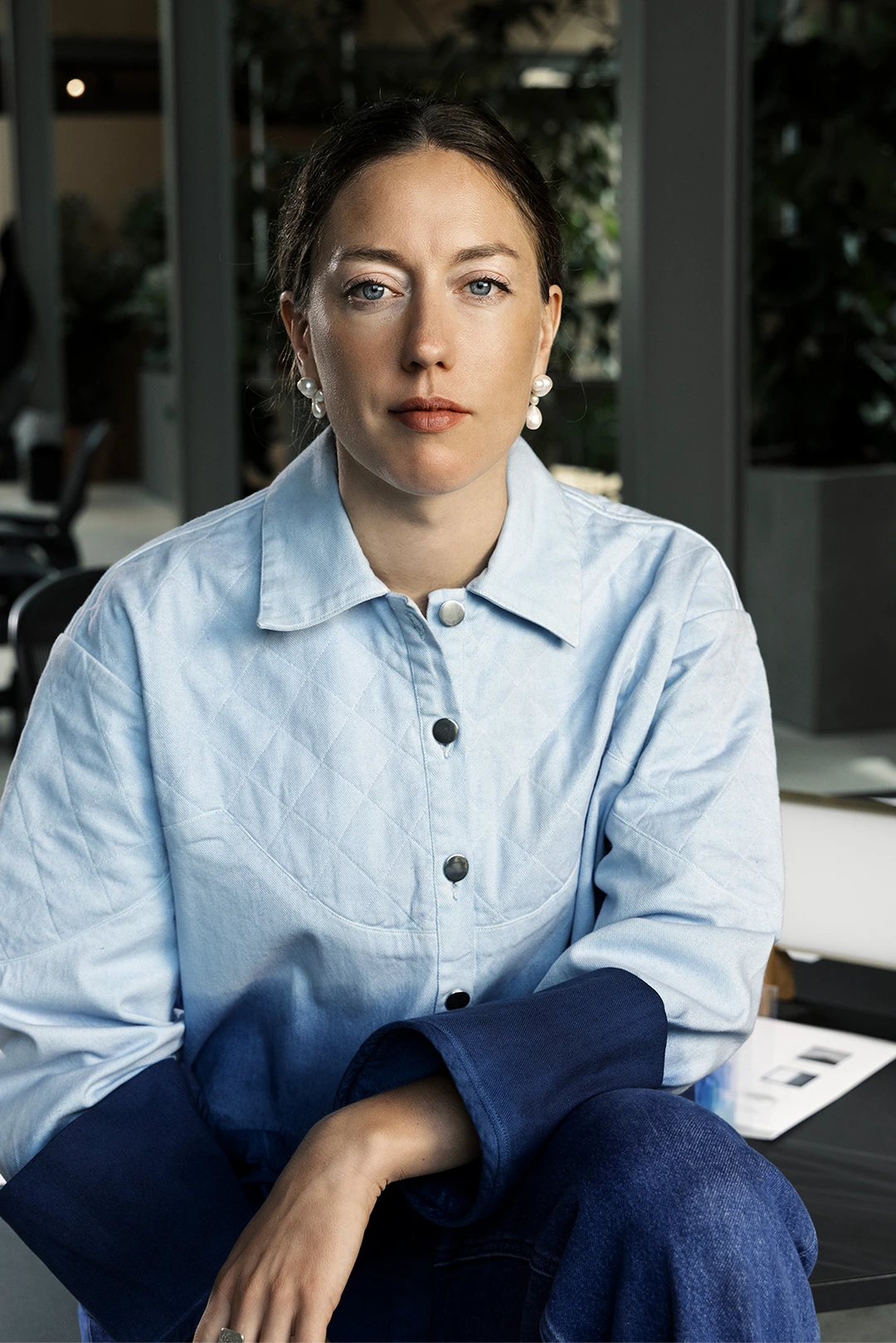
Marjan van Aubel is one of the leading voices in contemporary solar design, internationally recognized for transforming sustainable energy into functional and poetic objects.
Based in Amsterdam, the Dutch designer has built a remarkable career at the intersection of technology, design, and environmental innovation. After graduating from the Gerrit Rietveld Academy and later earning a Master’s degree in Design Products from the Royal College of Art in London, van Aubel quickly gained global attention for pioneering projects that integrate solar technology into everyday life.
Her acclaimed works — including "Current Table", "Current Window", and the award-winning solar light "Sunne" — have redefined how renewable energy can exist within design, architecture, and public space.
Her projects have been exhibited internationally, featured by institutions such as the Design Museum in London and the Museum of Modern Art in New York, and recognized with numerous prestigious awards for innovation and sustainability.
Beyond product design, van Aubel is also an influential public thinker and advocate for a solar-powered future. From her TED Talk "The Beautiful Future of Solar Power" to founding the Solar Biennale alongside fashion designer Pauline van Dongen, her work continuously explores how design can reshape humanity’s relationship with energy, beauty, and the environment.
In this interview, we speak with Marjan van Aubel about the future of solar design, the role of creativity in sustainability, and how innovation can inspire cultural and societal change.
CDH Talks: Welcome dear Marjan to Culture Diplomacy Hub. You often speak about "solar design" as a movement — what defines it culturally, not just technologically?
Marjan van Aubel: Solar has been told as a story of efficiency, payback time and blue rectangles on a roof. That is a technological and economic narrative, and it has taken us very far — but it is not the language people fall in love with. What I call solar design is the cultural project that sits next to the technical one: it asks what we _want_ from the sun, not only what we can extract from it.
It brings imagination, aesthetics, ritual and human scale back into a conversation that has been dominated by engineers and utilities. The movement is defined by a shift from infrastructure to relationship — designing objects, spaces and stories that let people feel the sun, not just extract it. Many renewable solutions prioritise efficiency over beauty.
CDH Talks: Why was it important for you to make solar design visually compelling?
Marjan van Aubel: Because beauty is not decoration; it is a force of adoption. When something is beautiful, you want it near you. You point at it, you photograph it, you place it in your home. That emotional pull is what efficiency curves can never produce on their own.
We treat cars, phones and kitchens as lifestyle, but we have asked solar to live on the roof, out of sight, judged only on watts. If we want a post-fossil world, the technology has to walk into the living room — and it has to be desirable enough that people invite it in. Beauty is how you turn a climate solution into something people choose, rather than something they tolerate.
CDH Talks: In your opinion, can design act as a form of soft power in addressing climate change?
Marjan van Aubel: Policy persuades through obligation, science through evidence, activism through urgency. Design persuades through experience. A well-designed object reframes a question before anyone has to argue about it. Soft power is shaping desire and default behaviour without demanding agreement first.
If a solar window is more beautiful than a tinted one, the climate argument has already been won at the level of taste. We underestimate how much of the energy transition will actually be decided in showrooms, on Instagram, at fairs and in interiors — not only in parliaments.
CDH Talks: Could solar design become part of a shared global cultural identity, much like architecture or fashion?
Marjan van Aubel: I think it already is becoming one — and it should. The sun is the most universally shared resource we have; every culture has worshipped it, oriented buildings to it, eaten and dressed around it. So solar is a perfect candidate for a shared visual language, in the way modernist architecture or denim became globally legible.
But — and this is essential — it cannot be one aesthetic exported from one place. The sun behaves differently in Lagos, Rotterdam, Tokyo and São Paulo, and the design response should follow. The shared identity is the relationship to the sun; the dialect should stay local.
CDH Talks: Have you seen your work resonate differently across cultures or regions?
Marjan van Aubel: Definitely. In Northern Europe people respond to a piece like Sunne almost emotionally — it is about the sun you do not have, a kind of stored daylight in the house. In sun-heavy regions the conversation is more practical, more about shade, agriculture, cooling, abundance.
When we travelled the Solar Biennale we deliberately moved it because the sun is not a constant — it is a different cultural character in each place. That has been the most useful education of my career: realising that "solar design" cannot mean one thing globally, and that the work gets stronger when it listens to the climate, light quality and rituals of where it lands
CDH Talks: You've worked with both cultural institutions and global brands — how do you maintain integrity while scaling your ideas?
Marjan van Aubel: The rule in the studio is that the project has to push the message forward, not just decorate the brand. With museums it is easier — they exist to host ideas. With commercial partners we ask earlier, harder questions: what materials, what end-of-life, what story is being told, and what changes inside the company afterwards.
If a collaboration only produces a beautiful object and no internal shift, we have made an advert, not a project. Going a layer deeper — into raw materials, into upcyclability, into who actually makes the cells — is how I keep the work honest as it scales. Beauty on the surface, substance underneath; that order matters.
CDH Talks: What kind of partnerships are still missing in the solar design space?
Marjan van Aubel: The most obvious gap is between designers and the people who actually make photovoltaic cells. Material scientists and cell manufacturers rarely sit at a design table, and designers rarely walk into a lab. That is where the next aesthetic vocabulary of solar will come from — colour, transparency, flexibility, texture — and it is still locked behind an industrial wall.
We also need closer partnerships with energy utilities and policymakers, because design alone cannot rewire a grid, and with educators, because the next generation of solar designers does not yet have a curriculum. And, frankly, with farmers, architects and urban planners — the sun touches all of them before it touches a product.
CDH Talks: Designers today are increasingly expected to solve global problems. Do you see this as an opportunity or a burden?
Marjan van Aubel: Both, and you have to be honest about that. The opportunity is enormous — design has finally been promoted from styling to systems, and we are being trusted with questions that used to belong to engineers and economists. The burden is the quiet expectation that a chair, a lamp or a façade can fix what industries and governments have not.
I try to refuse the hero narrative. Designers are translators, not saviours. We make the abstract tangible, the technical desirable, the future imaginable — and that is a serious contribution. But it only works if we stay in coalition with science, policy and community, instead of pretending we can do it alone.
CDH Talks: What responsibility do designers have in shaping public understanding of climate issues?
Marjan van Aubel: A real one, because designers control the interface between people and almost everything they use. Every object teaches something — about value, about waste, about where energy comes from. If our objects keep hiding their consequences, the public will keep underestimating the stakes.
So the responsibility is to make impact legible: to show where energy is generated, where materials come from, what happens when something is finished. Climate communication has been left to charts and headlines for too long; it lives much better in the hand, in the home, in the street. Designers can move the conversation from fear to gency simply by making the alternative visible and inviting.
CDH Talks: Is there a risk that sustainability becomes just an aesthetic trend?
Marjan van Aubel: Yes, and it is already happening. Earth tones, raw linen, exposed wood, mossy greens — a whole wardrobe of "looking sustainable" has emerged that often has very little to do with the actual material story behind it. The risk is that sustainability turns into a mood board, and the public learns to recognise the costume rather than the substance.
My defence against that is to insist on the layer underneath: what is it made of, who made it, what does it produce, where does it go next. If a project survives those questions, the aesthetic is earned. If it does not, it is a green stage set — and the climate does not respond to stage sets.