Kate Howe: What does culture do when violence is made beautiful?
In a world where culture is often consumed as surface—beautiful, immediate, and unchallenged—Kate Howe’s practice asks us to slow down and reconsider what lies beneath the act of looking. Their work explores how violence, history, and power are not only represented in images, but also softened, aestheticized, and made desirable through the cultural “frames” that surround them: institutions, language, education, and taste itself.
In this conversation with CDH Talks, Howe expands on the central question that underpins their practice: What does culture do when violence is made beautiful? From Titian’s “Rape of Europa” to the museum space as a site of learned perception, Kate Howe reflects on how meaning is shaped before we are even aware we are looking—and how that shaping can obscure the ethical weight of what we see.
At the heart of the discussion is a persistent tension between admiration and awareness, between inherited ways of seeing and the possibility of choice. Howe ultimately invites us to consider whether it is possible to remain inside culture’s frames while also seeing them—clearly enough to decide, consciously, how we respond.
CDH Talks: During our initial conversation and reflections on cultural diplomacy, you introduced your work through a remarkable question: What does culture do when violence is made beautiful? Given that your practice has explored this issue so deeply, how would you answer that question?
Kate Howe: I think it boils down to this: when violence is made beautiful, culture teaches us not to see it as violence at all, but to admire it as beauty – something to aspire to.
I remember sitting in front of Titian's Rape of Europa during his Love, Desire, Death show at the National Gallery in 2021. I sat on a bench in front of this remarkable painting for a couple of hours, just looking. There is something about the object itself, the immediacy of the scale, the physical presence of the paint, that allows for dialogue in a way that a photo never can.
So, I'm sitting there, remembering my last contact with this painting when I was much younger, at the Isabella Stewart Gardner Museum in Boston. That experience was much colder - culture stood, in a way, between myself and the painting. The need to perform my gender well (femininity is often learned as competitive) lay over me like a carapace. Thirty-five years later, I sat with that carapace burned away by life experience, therapy, necessity and time.
At one point at the NG, a couple walked in front of me, and stood in front of the painting. He put his arm around her. After a few moments, she rested her head on his shoulder. "I love this painting." She sighed.
I understand. I also love this painting. Titian was remarkable, a direct painter, his impulsive nature comes through in audacious choices that don't always work out, and we love him for it. For instance, Zeus, in this painting, having transformed into a massive milky white bull, has a teeny tiny head. Titian has a bad case of "welcome home syndrome" here as he runs out of room. Nonetheless, it is the bull's gaze we are drawn to. It looks at us with a knowing, nearly lecherous glance. "Oh yeah, baby. You know what's coming." He says, as he paddles through the water, churning frothy white, as he abducts Europa and takes her off to an island for her rape.
The question might be: can we separate the work from the person who made it, or from the conditions that made it possible? I think that only gets us part of the way there. I am not interested in cancelling Titian, or locking these objects away. That would be too simple, and not very useful. The more difficult question is: What happens when culture teaches us how to love them? Why does that happen?
For me, this takes us to the frame – and stay with me here, I promise this is important. Start with the literal frame first: gilt, ornate, old, heavy with authority. Before we have even looked properly, it is already telling us something. This is art. This matters. Behave accordingly. Derrida writes about the frame in a way that is useful, because the frame is not as stable as it pretends to be. It marks the edge of the work, yes, but it also seems to vanish.
If I look at the painting, the frame starts to belong to the wall. If I look at the wall, the frame starts to belong to the painting. It is there, doing its job, while slipping out of notice. The frame is most powerful when we stop seeing it.
Many things act as frames. The museum is a frame. Curatorial choices are a frame. The canon is a frame. The wall text is a frame. Titian’s reputation is a frame. The exhibition lighting is a frame. Historical distance is a frame. Each one tells us how to look before we have worked out what we feel. The frame says trust this; this is greatness; this is beauty; this is culture. And if the subject is violence, those frames can soften that violence before we have had the chance to recognize it, and therefore question it. Not reject it. Become aware of it and make our own decisions about how we feel when we see it.
What I want is to give that young woman in front of the painting a moment to feel her way through it. To see the image, understand the story, understand the room she is standing in, and maybe even reject the whole thing if that is what her body tells her. But the force piles on so quickly. It’s the National Gallery. It’s Titian. It’s Ovid. It’s in a beautiful frame. I learned in school that this was a special, important, beautiful painting. And under all that trained admiration, the frames fade away. And with it, maybe, our ability to choose.
That is the part I want to make visible. I want the frame to fail just enough that we can choose our response. I want us to be able to love the painting and still see the problem.
CDH Talks: So, the frame is never neutral?
Kate Howe: Exactly. Not only is it never neutral, it is acting on us, while sliding into invisibility. Think of this - what exactly has to be softened, displaced, translated, or ignored in order for violence to become available as admiration?
The problem is not simply that a powerful man commissioned a painting of abduction for his private rooms. (I lovingly refer to this set of paintings as King Philip II of Spain’s spank bank – startling that we should stand in front of his personal titillation material in the National Gallery. Lucky that we can. Sad that it is hard to understand what we are seeing.)
The problem is that, centuries later, we can still stand in front of that image and feel admiration in our bodies before we feel recognition of the content, which would lead to choice. It is the set of frames, carrying invisible authority, that help remove this agency.
So, what then? How do we engage with these works? Why are they problematic in the first place? Separating the commissioner, and the artist, we can come to the modern problem: A young woman stands in front of a painting with the issue right there in the title: The Rape of Europa. I do not find the “rape meant abduction back then” argument comforting. Abduction is also violence, just ask the Sabine Women.
The issue is not whether we call it rape or abduction. The issue is why culture has worked so hard to make either one beautiful!
I am not saying paintings should not exist that depict violence, abduction, rape, or any other mode of human life. They should. This is part of our record. What I am asking is why this image of violence has been so successfully framed as beauty. The answer is that the frame of culture makes this violence – Europa is often imagined as very young in this story – and deceived, abducted, sexually violated and impregnated – an image of beauty.
It softens it. The bull is beautiful. Europa is operatically glorious as she slides off his back. The ochre shadows bouncing off her dimpled thighs are exquisite. The maidens on the shore wave her away merrily. Europa clutches and waves the red scarf of passion as she is carried away to her lucky, exciting, scary fate.
Lucky her.
What does this object teach? Perhaps that one should be a direct painter, and just go for it, splashing lead white across the tops of the carefully rendered waves at the last second. Perhaps also that to be successful as a woman is to be desired.
That to be desired is to be pursued. To be pursued is to have been chosen. To be stolen is to have been chosen. To gain attention of the gods is to have been chosen. And this can lead to a set of puppet strings that might tie a young woman in knots, when, in contemporary society, she feels obligated to feel grateful for attention she does not really want.
CDH Talks: Your work has a powerful capacity to draw viewers into deeply personal and often uncomfortable spaces of reflection. Could you share a moment from one of your exhibitions when a visitor's emotional responses revealed something significant about the impact of your work?
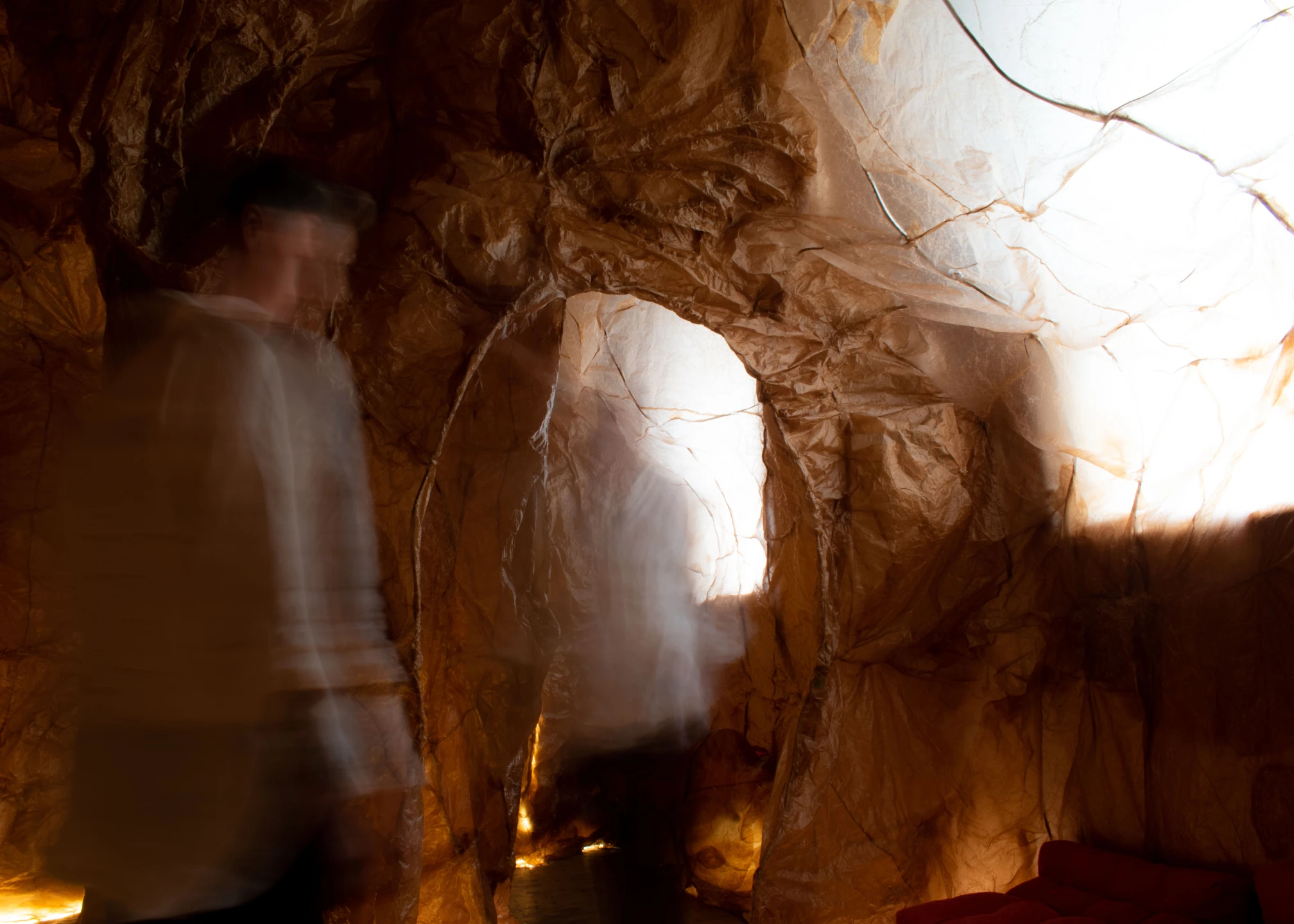
Kate Howe: During my installation of the Templum at Orleans House Gallery, I saw people enter the installation and change their pace almost immediately. The work is made from kilometers of smashed, sewn and patched amber waxed paper, and it glows. It changed the environment’s light, sound, and atmosphere in a way that asked people to slow down. It was not didactic. It did not tell visitors what to feel. But many people became quiet inside it. Some cried. Some stayed much longer than expected. Some returned repeatedly.
We would walk around at the end of the day and find people quietly chatting, no phones anywhere, people crashed out on the meditation cushions and napping, or listening, or just being – together, separate.
What moved me were not only the tears I witnessed themselves, but the kind of permission those tears seemed to reveal. The space allowed people to access something that every day public life often prevents: stillness, grief, tenderness, awe, memory, or a bodily sense of being held. I can’t tell you the number of people who said they felt that the space became their own body after spending time in it, and this sense of being held translated into some sort of geologic time, some deep ancient being that they also were a part of, or that was a part of them.
I think that matters because much of my work is about the way institutions train us to behave – this is the frame of the museum. In many museum spaces, people perform comprehension. You see performative looking, gesturing, explaining, selfie taking.
They look at the ‘right’ works and move past the ones they aren’t sure about. In other words, they admire correctly. The Templum asked for a different kind of attention. When I was giving an artist's talk one afternoon to a group of about twenty-five visitors, mostly women, one moment in particular stood out.
A father had brought his high-school aged daughter to the exhibit. They had roamed through the structure, listened to the extraordinary soundscape written by Nick Parkin, and dropped into a deeper register. They had not intended to stay for the artist's talk, but the daughter found herself wanting to know more.
Every one of these talks was different, each responding to viewer's individual questions, and this one, like many, gained traction around misogyny, fear, danger, and our desperate need for another way to ask for every one of us to take some form of radical responsibility for the way we are complicit in this teaching as it greases the wheels of the powerarchy's hold over us. As we blindly climb toward "progress" without asking what we are progressing toward, what we are abandoning in pursuit of acceptance, social capital, and personal power.
As the discussion unfolded, the father began to ask more and more urgent questions about patriarchal values, about the damning of feminism, about the history of slippage in our pursuit of the right to exist as whole and equal people. After the talk ended, they stayed on, and we continued our discussion.
Suddenly, he broke down in tears. "I just had no idea. I had no idea she was in danger; I had no idea I was complicit. I am thinking over the values I held as 'normal' for so long – I think about the things I must have taught her without even knowing it, and I am ashamed."
What a moment. The daughter was stunned. Not embarrassed. Amazed. We took some time here, we talked about how to move forward, how guilt doesn't serve once it has pried loose the scab of shame, about how action is possible, about how it is not too late to value his daughter as a person worthy of agency.
I think it’s important to state here that he was not confessing to being a monster. He was seeing a frame he had inherited. He was seeing how values he held, whose origins had been previously unquestioned, felt normal, protective – loving – might actually carry danger. I’m not into shame as an endpoint, I’m fighting towards recognition as the beginning of a radical responsibility, one that might, over time, gain speed, and emancipate us all.
I saw this family several times that summer. I will never ever forget this encounter. It is the engine that continues to fuel my practice.
CDH Talks: I often feel that your intellectual approach and artistic perspective move beyond the confines of ideological frameworks, offering a more nuanced understanding of power, violence, and human experience. How would you describe your perspective on these issues?
Kate Howe: For me, the question is always: what has been made to feel natural that is actually constructed? I have this radical internal urge to resist these days. I am unsure of why we think what we think. And I think there is a line that moves directly from admiration to control.
So, I ask – what has been presented as beautiful that is actually violent? What has been called protection that is actually control? What has been called knowledge that is actually gatekeeping? This is where my work sits. It is also epistemological, institutional, material, and human. It asks how we came to believe certain arrangements were inevitable — and what might become possible when we stop believing that.
So, I suppose I am most interested in the mechanism – that set of connected actions where the invisible frame teaches us how an object becomes an authority, authority becomes taste, taste becomes aspiration, aspiration becomes self-policing, and our agency, to some extent disappears.
When this happens, power becomes intimate. We become puppets. And we don’t even feel the strings. My work is trying to slow that process down enough that we can see it happening.
CDH Talks: Do you think there is a risk that critical discourse may itself become a new orthodoxy?
Kate Howe: Yes, absolutely. Anything can become orthodoxy once we begin to blindly follow it. Critical questioning means noticing. Noticing when we are beginning to perform in order to belong, this is the slippery slope I am talking about.
It takes energy not to fall into that trap. It is much easier not to question, to let the algorithm feed you, to keep scrolling, to keep visiting the same art works, to keep believing they are the most important, the most beautiful, and to value that beauty over our ability to read context and deeper content. And this is the behavior that keeps us trapped.
I think volume has something to do with it. And yes, critical discourse can become a kind of performance. It can become another way of proving you belong, another way of speaking correctly, another way of punishing failure.
But the backlash against “woke” can also become an orthodoxy. The fear of getting it wrong against the power of that ancient frame trains people not to notice. It makes awareness embarrassing. Cringe even! It makes people afraid to say: wait, who built this? Who benefits from this? Why did I learn to admire this? Why did I learn to want this? Why did I learn to call this normal? Why am I so broke, why do I need to spend so much, to throw away so much, to post so much, to check if I am okay so much?
My work is not interested in replacing one set of obediences with another. That is the horror we sort of live in already. I’m just always asking, where is the off ramp? How do we change this perpetuating system that chews us all up and spits us out?
I am not trying to tell people what they are allowed to love, wear, do or be. I just want to know you chose it – and that you knew, to some extent anyway, what you were choosing. I am trying to tear back the curtain far enough that we can see the puppet strings – and these are not always held by one specific villain of the left or the right - that is a distraction created by the frame - but rather threaded through an old, uncaring system that keeps moving through us.
In art, that system can teach admiration. In gender, it can teach aspiration. In the body, it can become self-surveillance. In politics, it becomes obedience. And it is exhausting. So yes, of course there is a risk. That’s why it is scary to question – to look behind, to try to see the mechanism. There is always a risk.
The question for me is whether we can find a way, perhaps through an encounter with an artwork, perhaps through an affective shift that might trigger critical thought, to keep the frame visible, to watch it fail. This lets us become aware of the mechanism, so we can choose.
Choose as you like, but please – let us know what we are choosing, and why.