Inside Sara Brajović’s Exhibition Space During Art Basel Paris
Paysage intérieur: Art, Design, Decorative Arts and the Landscape of Memory
During Art Basel Paris, the French capital becomes a meeting point for artists, collectors, galleries and international cultural voices. Beyond the exhibitions and art market, the city’s independent artistic spaces offer a closer look at the ideas, sensibilities and personal visions shaping contemporary collecting and cultural life.
Culture Diplomacy Hub steps inside Sara Brajović’s exhibition space, presented in collaboration with Gallery Taramis, to explore the thinking behind Paysage intérieur — an exhibition that brings together art, Italian design and historical decorative arts through the intimate lens of memory.
Rather than approaching objects as isolated works or markers of a particular period, the exhibition considers how they acquire meaning through personal experience, cultural references and their relationships with the spaces they inhabit. Here, the interior becomes a place where art and design intersect with memory, revealing the stories objects carry and the new associations they create.
A Dialogue Between Art, Design and Time
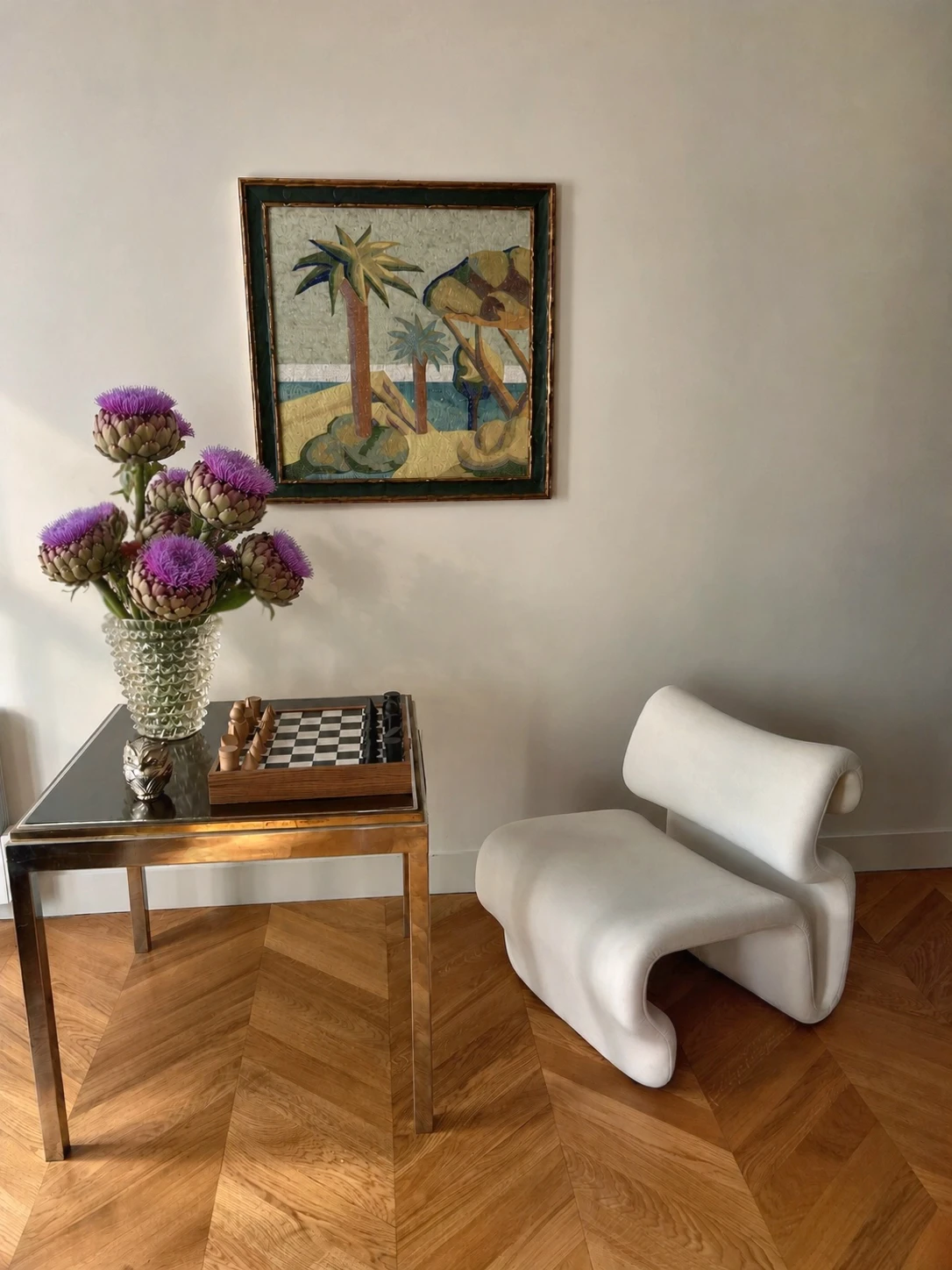
At the heart of Paysage intérieur lies an encounter between different artistic traditions, historical periods and cultural geographies. Mosaic landscapes by Salvo, a seventeenth-century Aubusson tapestry depicting a bucolic scene, and a Chinese lacquered screen animated by trees and fauna establish a dialogue across materials, histories and visual languages.
Mosaic, woven textile and lacquered surfaces become different expressions of a recurring motif: nature. Rather than presenting landscape solely as an image of the external world, the exhibition approaches it as a connecting thread between cultures and centuries.
These works coexist with Italian design and historical decorative arts in an arrangement that resists rigid distinctions between periods and disciplines. Their relationship is shaped by visual affinities, textures, colours and forms, allowing each object to contribute to a broader composition.
The result is an interior in which the significance of individual pieces extends beyond their original context. Their placement creates new connections, demonstrating how collecting can bring together objects that might otherwise remain separated by time, geography or artistic tradition.
An Italian Sensibility, Shaped by Personal History
The predominantly Italian collection reflects an important chapter in Sara Brajović’s personal history. During her formative years as a young adult, she spent much of her time between Rome and Paris, while the apartment in which she grew up was filled with Italian design from the 1970s.
These experiences helped shape her aesthetic sensibility. The objects she brings together evoke places, encounters and interiors that have contributed to her visual vocabulary, revealing collecting as a personal process informed by lived experience as much as by an appreciation of design.
Among the designers whose work continues to attract her attention are Ettore Sottsass, Mario Bellini, Carlo Scarpa and Rizzo. Their distinct approaches to form, material and the relationship between objects and their surroundings contribute to the wider design culture that informs the exhibition.
Within Paysage intérieur, these references are not presented simply as examples of design history. They become part of a more intimate composition, in which personal associations and aesthetic preferences establish connections between objects from different contexts.
The collection consequently offers a perspective on collecting that extends beyond chronology or stylistic classification. It suggests that a collection can also be understood as a portrait of the person who assembles it — a record of encounters, affinities and moments that continue to resonate over time.
The Landscape of Memory
Memory is the underlying principle connecting the exhibition’s different elements.
A familiar silhouette, a particular texture or an unexpected combination of colours can summon an atmosphere from the past. Sometimes, the association emerges before the memory itself can be fully articulated, revealing the subtle ways in which material objects become connected to personal experience.
This is where Paysage intérieur acquires its Proustian dimension. In the literary universe of Marcel Proust, sensory experiences can unlock memories that seem distant or inaccessible. Similarly, objects within an interior can become catalysts for recollection, allowing fragments of personal history to return through form, colour and texture.
Through collecting, these associations take tangible form. An object may recall a city, a room, a period of life or a particular sensibility. Placed alongside other objects, however, its significance can evolve, generating new relationships between individual memory and shared cultural references.
The exhibition invites visitors to consider how interiors accumulate meaning over time. The spaces we inhabit are rarely neutral: they are shaped by what we preserve, what we choose to display and the associations we attach to the things around us.
In this sense, the interior becomes more than a physical arrangement. It becomes an expression of identity — an inner landscape made visible through objects.
The Art of Bringing Different Worlds Together
The interiors of Yves Saint Laurent and Pierre Bergé provide a reference for this approach to collecting and composition. Their interiors exemplify the freedom to bring together works and objects from different periods and cultures, allowing a distinctive personal vision to establish coherence among them.
The significance of this approach lies not in strict stylistic uniformity, but in the ability to recognise affinities between objects that might otherwise remain separated by historical period, geography or artistic tradition.
Coherence emerges through the eye of the collector: through intuition, knowledge, personal attachment and the ability to recognise unexpected relationships.
This principle resonates throughout Paysage intérieur. Historical decorative arts, artistic expression and Italian design are not treated as separate chapters in a conventional survey. They meet within a shared environment, where their differences contribute to the richness of the whole.
The exhibition also raises a broader question about the nature of taste. Is taste defined by established categories and historical classifications, or does it emerge through an individual's capacity to recognise meaning across different worlds?
Here, collecting becomes an act of interpretation. It is a way of creating a personal visual language from objects that carry their own histories while acquiring new significance through their encounter with one another.
The Interior as Autobiography
The title Paysage intérieur refers both to the landscapes represented throughout the exhibition and to an inner landscape composed of places, experiences and recollections.
It also suggests a way of understanding interior design as an evolving form of autobiography. Rather than treating a room as a finished composition, the exhibition presents it as something that develops alongside the person who inhabits it.
Taste changes. Memories resurface. Objects acquire new meanings as they move through different stages of life. An interior can therefore become a living record of personal evolution, reflecting not only who we are, but also the experiences that have shaped us.
Within this perspective, the objects we choose to live with assume a significance that extends beyond their aesthetic or material value. They become part of the environments through which we understand ourselves and communicate aspects of our identity to others.
Paysage intérieur ultimately proposes that an interior is never simply a collection of objects. It is a relationship between things, memories and the person who brings them together.
Beyond the Exhibition Space
During Art Basel Paris, when international attention turns towards the artists, galleries and collectors shaping the contemporary art landscape, Sara Brajović’s exhibition offers a more intimate perspective on the cultural significance of collecting.
Rather than focusing exclusively on the market value or historical classification of objects, Paysage intérieur explores the personal and cultural narratives that emerge when different artistic traditions share the same space.
It suggests that the meaning of an object is never entirely fixed. Its history matters, but so do the memories it evokes, the relationships it establishes and the context in which it is encountered.
Paysage intérieur invites us to reconsider the relationship between the objects we collect and the lives we lead. An interior can be a reflection of taste, but it can also become a record of memories that remain with us.