FRANCESCO MARCHIARO: Unique cultural moments have become one of the most valuable forms of luxury
The Floating Art Hotel arrives at a moment when the boundaries between contemporary art, hospitality, and experiential luxury are becoming increasingly fluid. Conceived as a travelling cultural platform, the project brings museum-quality contemporary art into dialogue with high-end hospitality, activated within international environments where culture, mobility, and global audiences converge.
Launched in Monaco during Grand Prix week, the inaugural edition, States of Motion, reflects both the intensity of its context and a broader shift in how culture is now experienced — less as a static encounter, and more as a sequence of curated, immersive moments shaped by place and movement.
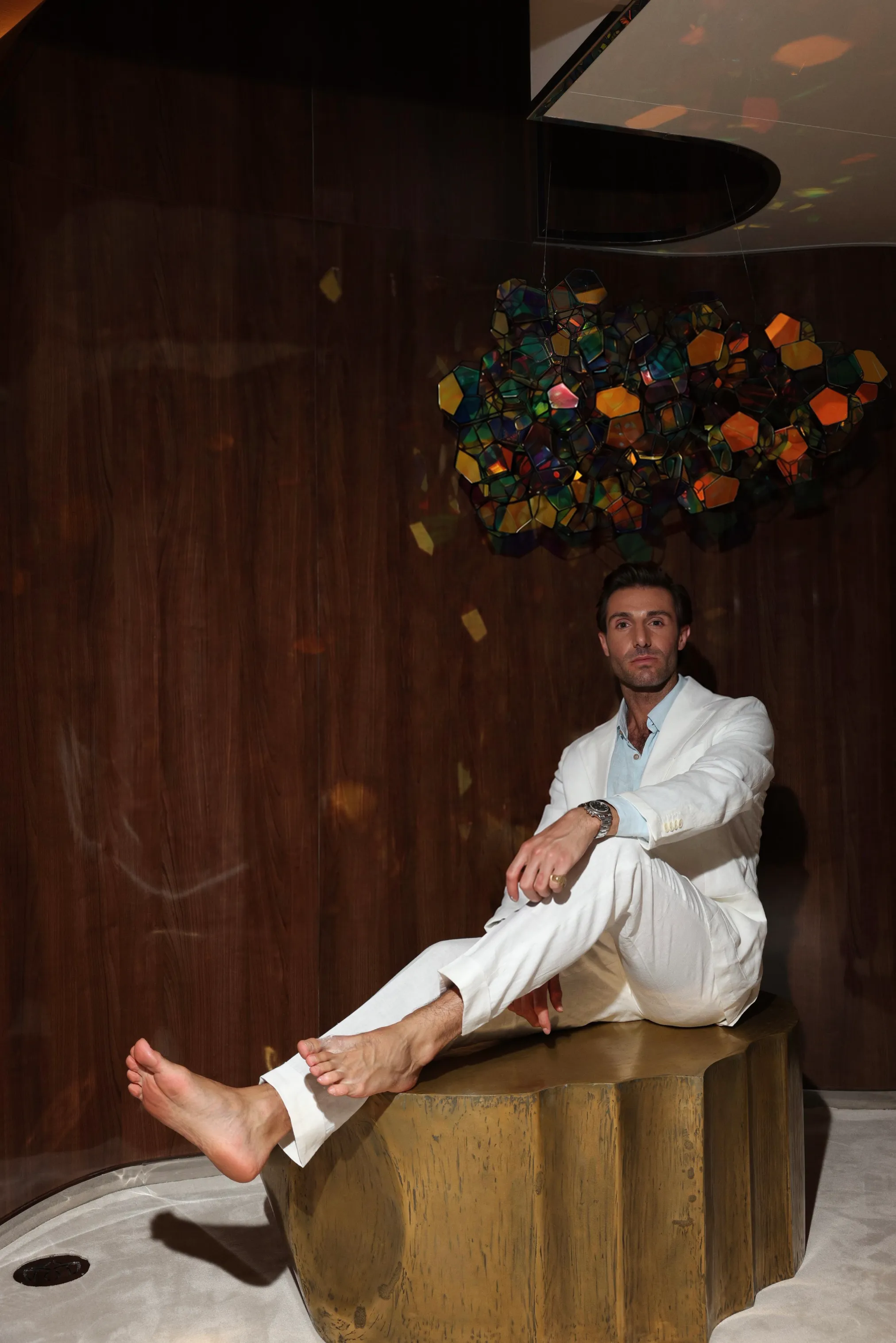
At the centre of the exhibition is Francesco Marchiaro, curator of The Floating Art Hotel, whose approach frames the initiative not as a conventional exhibition space, but as a mobile cultural structure. One that responds to its environment, engages with local artistic ecosystems, and rethinks the relationship between art, audience, and setting.
In this conversation, he reflects on the curatorial logic behind the project, its positioning within the evolving landscape of luxury, and the broader question of how cultural value is being redefined in motion.
CDH Talks: The Floating Art Hotel has been described as the world's first floating contemporary art hotel. What was your initial reaction when you first encountered this concept?
Francesco Marchiaro: My first reaction was that it felt both ambitious and surprisingly natural. For decades, the art world has sought ways to bring culture beyond the walls of traditional institutions. The Floating Art Hotel takes that idea a step further, transforming a yacht into a living cultural destination where art is experienced as part of a journey – surrounded by the sea, architecture, hospitality and human connection – rather than simply viewed.
What immediately excited me was that it addressed a clear shift in the luxury market. We have seen a growing demand for high-end experiences on the water, particularly within the yachting world, but at the same time there has been a broader move away from celebrity-led experiences towards those rooted in culture, authenticity and meaningful engagement. Today's audiences increasingly seek substance alongside luxury.
The hospitality industry has long embraced art as a way to enrich the guest experience and we have recently witnessed the rise of hospitality-led concepts within the yachting sector. Yet no one had truly brought these worlds together in a way that created genuine cultural value. The Floating Art Hotel bridges that gap by combining world-class hospitality with a curated artistic programme, creating a new model that speaks to the evolving expectations of luxury audiences.
CDH Talks: As curator, what guided your approach to the inaugural exhibition?
Francesco Marchiaro: For the inaugural exhibition, States of Motion, I wanted to explore movement in its broadest sense: physical, emotional, social, and environmental. Motion is at the heart of Monaco during Grand Prix week, but it is also a defining characteristic of our contemporary world. The selected artists approach this theme from diverse perspectives, ranging from technology and architecture to identity, nature, and human experience. My goal was to create a dialogue between internationally recognised artists and emerging voices, while ensuring that each work resonated with the unique setting of the yacht.
From the outset, we also established an important curatorial principle for the project: each edition would seek to showcase artists who are living and working within the region where the yacht is hosted. This is not necessarily about nationality, but about supporting the creative ecosystems that already exist in those places. Sustainability is a core value for us, and we wanted to avoid unnecessarily transporting artworks across the globe for an exhibition that may only last a few days. Instead, we aim to engage with local artistic communities and galleries, reduce our environmental impact and create exhibitions that feel genuinely connected to their destination.
In many ways, The Floating Art Hotel is not only about bringing art to extraordinary locations, but also about building meaningful cultural relationships with the places we visit.
CDH Talks: How do you curate art within a floating environment?
Francesco Marchiaro: A floating environment requires a fundamentally different curatorial approach. The yacht itself becomes an integral part of the exhibition. Rather than treating artworks as isolated objects, we consider how they interact with the surrounding landscape, the changing natural light, the movement of the sea, and the way guests navigate the space. The result is closer to a curated journey than a conventional exhibition. Each work contributes to an atmosphere that gradually unfolds as visitors explore the vessel, creating an experience that is as much about discovery as it is about art itself.
A yacht is not a traditional white-cube gallery, so in many ways the process happens in reverse. Rather than starting with a blank space and building an exhibition within it, we begin with the vessel's architecture – its cabins, decks, corridors, and communal spaces – and work backward to identify the artworks that can best inhabit and activate those environments. It is undoubtedly a more complex, but alsoa far more rewarding, process.
The constraints of the space encourage a deeper dialogue between the artwork and its surroundings, resulting in an experience that feels more intimate, immersive and personal. From amarket perspective, this also reflects a broader shift we are seeing within the cultural sector. Audiences are increasingly drawn to boutique, highly curated experiences and intimate settings, moving away from the traditional convention-centre or white-cube exhibition model.
CDH Talks: Do you believe luxury is shifting away from ownership?
Francesco Marchiaro: Absolutely. While exceptional craftsmanship and quality remain important, today's luxury audience increasingly seeks experiences that create lasting memories, intellectual engagement and emotional connection. Access to unique cultural moments has become one of the most valuable forms of luxury. People are no longer only collecting objects; they are collecting experiences, stories, and meaningful encounters.
CDH Talks: How does contemporary art create value beyond aesthetics?
Francesco Marchiaro: Contemporary art has the power to challenge perspectives, spark conversations and encourage reflection. Beyond its visual appeal, art can generate cultural, social and even economic value. It can connect people from different backgrounds, foster innovation and help us better understand the complexities of our time. In many ways, art serves as a lens through which we interpret the world around us. The most powerful art does not simply decorate a space, it speaks to us. Great art asks questions rather than providing answers. It challenges our assumptions, invites dialogue and encourages us to see the world from a different perspective.
For that reason, one of the core ambitions of The Floating Art Hotel was to make the exhibition itself as accessible as possible. While the hospitality element of the project is, by its nature, exclusive, we weredetermined that the cultural offering should not be. Every morning, we opened the exhibition free of charge to anyone who wished to visit and engage with the artworks. For us, it was important to distinguish between the hospitality model and the cultural mission.
The hotel experience may be reserved for a select audience, but the art was intended to be shared with the wider community. Ultimately, we believe that art creates its greatest value when it brings people together. By opening our doors to collectors, curious visitors, local residents and first-time art viewers alike, we hoped to create moments of discovery, conversation, and connection that extended far beyond the walls of a traditional exhibition.
CDH Talks: What does cultural authenticity mean in luxury today?
Francesco Marchiaro: Cultural authenticity has become essential. Audiences are increasingly discerning and can quickly distinguish between genuine cultural engagement and superficial branding. The most successful luxury projects create meaningful collaborations with artists, cultural institutions and creative communities. Authenticity builds credibility, relevance and emotional resonance, all of which are ultimately far more valuable than spectacle alone.
For the Monaco edition of The Floating Art Hotel, we were determined not to simply place artworks within a luxury environment. Instead, we set out to create a living, breathing cultural space. The exhibition wasdesigned to be experienced, not just observed. Throughout the week, artists were present on board, engaging directly with collectors and guests, sharing their ideas, discussing their practice and creatingopportunities for genuine dialogue. Performance also played a central role in bringing the project to life. The week opened with a performance by Jorge Parra, setting the tone for the days ahead and concluded with aperformance by Ana Maria Caballero. These moments transformed the yacht from an exhibition venue into a cultural gathering place where art could be experienced in real time.
For collectors and cultural audiences alike, authenticity comes from substance. It comes from meeting the artists, understanding the stories behind the works and participating in meaningful conversations. This wasnever intended to be a decorative project or a luxury backdrop for socialising. The art was the reason people came together and that commitment to culture ultimately gave the experience its authenticity.
CDH Talks: Why launch in Monaco?
Francesco Marchiaro: The concept of The Floating Art Hotel is, in many ways, simple in its architecture: a floating hotel that combines ultra-high-end hospitality with museum-quality art during major international cultural moments where a yacht can naturally become part of the destination. The model is designed to travel to occasions such as Formula One weekends, Art Weeks, Design Weeks, Fashion Weeks and other global gatherings where culture, luxury, and influential audiences converge.
Monaco felt like the natural place to launch. It was a familiar environment for the team, one in which we already had experience and established relationships. There was also something personally meaningful about beginning here. I first met Gaëlle, the project's founder, aboard another yacht in Monaco the previous year. Returning to launch The Floating Art Hotel in the same setting felt somewhat cathartic.
Beyond that personal connection, Monaco offers a unique convergence of culture, innovation, hospitality and international influence. During Grand Prix week, it becomes a global meeting point for leaders across business, technology, design and the arts. Launching The Floating Art Hotel in Monaco allowed us to introduce the concept to a highly international audience while placing contemporary art at the centre ofone of the world's most iconic luxury destinations. Launching during one of the year's most dynamic and fast-paced weeks also carried a certain symbolism. Monaco is often associated with speed, performance and movement, making it the perfect setting for our inaugural exhibition, States of Motion. The destination and the curatorial theme felt intrinsically connected.
CDH Talks: How do you see Monaco's cultural role evolving?
Francesco Marchiaro: While Monaco may not traditionally be spoken about in the same way as London, Paris, or New York when it comes to the art world, it has long possessed a rich cultural heritage and a deep relationship with the arts. Art has always been woven into the fabric of the Principality, from the Princely family's collections to its museums, cultural institutions, and longstanding support of creative initiatives. In recent years, Monaco's cultural profile has become increasingly visible on the international stage.
We have seen major museum-quality exhibitions brought to the Principality, ranging from presentations of masterpieces from the Centre Pompidou to exhibitions dedicated to artists such as Turner, Monet, and Giacometti. At the same time, Art Monte-Carlo continues to grow in significance, attracting leading galleries, collectors and institutions from across the world.
The Principality is also investing in integrating art into public life. The installation of a monumental Alexander Calder sculpture in the newly developed Mareterra district, drawn from Princess Grace's personal collection, powerfully demonstrates how Monaco is embedding culture within its urban landscape. The Prince's Palace houses remarkable works of art, while the country is home to some of the world's most prominent galleries, auction houses, and private collections. Monaco's unique ecosystem naturally creates strong cultural demand. It brings together an international community of entrepreneurs, innovators, collectors and patrons who increasingly seek experiences that go beyond traditional luxury. As a result, we are seeing growing investment in museums, public art, cultural programming and creative initiatives throughout the Principality.
CDH Talks: : Vision for the future??
Francesco Marchiaro: As The Curator of the inaugural Monaco edition,more than anything, I hope The Floating Art Hotel becomes known forcreating exceptional cultural experiences that are both intellectuallyengaging and deeply human. If TFAH builds a platform that supportsartists, fosters meaningful conversations and brings together peoplefrom different disciplines and backgrounds, I believe it will havecreated something with genuine and lasting value.