DINA JOHNSEN: Embrance of multicultural monography
Dina Johnsen – an artist formed by many worlds. Her international sojourns (Kazakhstan – Moscow -Belgrade – Oslo – Amsterdam – Stockholm) give her a trans-cultural perspective, which may make her work appeal to global audiences.
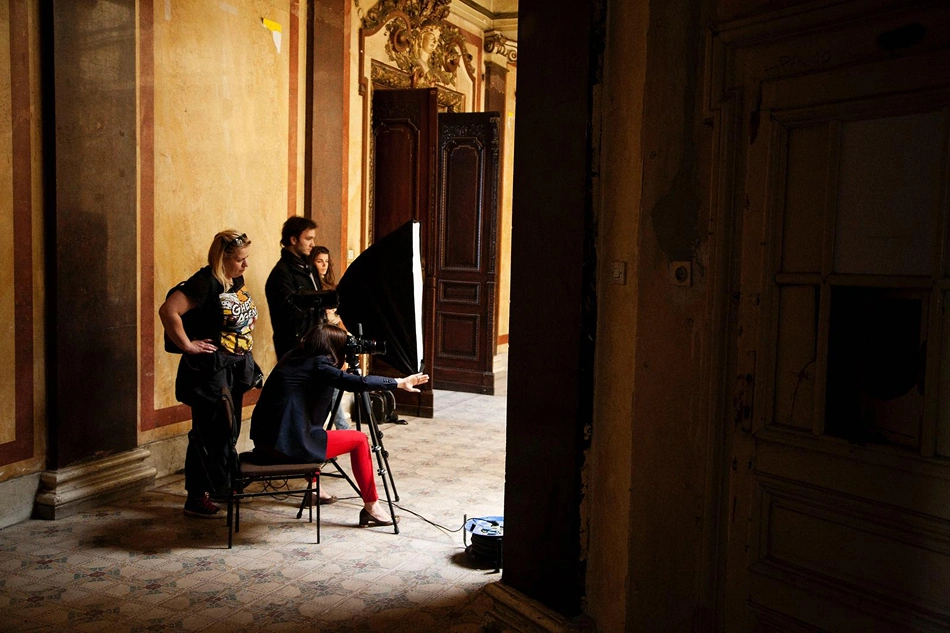
Between 2010 and 2012, she published two coffee-table books devoted to the Belgrade’s vibrant cultural scene: The Unseen Beauty, featuring the stars of the National Theatre of Belgrade, and The Belgrade Book, a visual tribute to the city itself. Her work sits at the intersection of photography, visual storytelling, cultural identity and city portraiture. She uses a visual medium (photo-monograph) to reflect a city’s identity – relevant for content that aims to promote place and culture.
During her stay in Norway (2012 – 2016), she was also photopraphed and interviwed the people who make difference in Oslo. In Amsterdam, she was active in philanthropy by supporting, together with her husband, a leading restoration project of the Rijksmuseum. The Night Watch by Rembrandt. Life in Amsterdam and later in Stockholm has become a big source of inspiration for Dina Johnsen. She creates abstract art using mixed-media and acrylic painting.
1. Is art, for you, an act of freedom or of belonging?
It is many different things. It is curiosity - when you create and dont know what happens next. It is an urge for challenge. The desire to connect with other people when doing photography. And finally, when I stay in the process and feel it is coming right, I feel so great, elevated, even blissful.
It happened so that I had to give up my professional career in fashion magazines at the age of 40, when I followed my husband and left Moscow for Belgrade in 2009, where we lived for 3.5 years. After a year of getting families with the city, I realized that I could do something in photography. This made me learn new things, meet new people, face quite some challenges and definitely enjoy the process and my life in Belgrade. I felt so happy there!
2. If you could describe your artistic mission in one sentence - what would it be?
In photography it is showing the beauty of others. In painting - exploration.
3. You photographed the soul of a cities through its people. What hidden energy did you find behind their eyes?
I would generalize a lot if I say something about everyone I photographed. Everyone has her or his own uniqueness. I think people want the world to see the best versions of themselves. It doesn’t have to be always a physical beauty necessarily. It can be how much they love and proud of what they do, or their bravery showing their vulnerability. I feel there is much more goodness hidden there in people than one could see at the first sight.
4. You successfully completed the project ''The Belgrade Book'' capturing a very emotional portrait of a city. What emotion or story did you want the world to feel when seeing Belgrade through your eyes?
I felt so happy and even sometimes emotional when working together with my Belgrade Book team. Especially, when a shooting would go really well and we would connected so greatly with a personality we were photographing. Thinking that we were doing something good together and for a good cause was very moving.
5. In the process of photographing Belgrade, what moment or person touched you the most?
It was quite a story. I was scouting together with Katarina Grcic Nikolic (she then worked and still works as costume designer at the National Theater of Belgrade). She was showing me one of the parks in Belgrade. We were there completely alone on a sunny summer day.
All of a sudden four giant homeless dogs approached and surrounded us. The dogs looked at us and growled angrily. I was scared to death, as I thought that at any moment they could rush at us and bite us half to death. I didnt know what to do. We froze. Katarina was calm. I even saw a slight smile on her face. She looked at me carefully, and said quietly: “Don’t move. Don’t look them in the eyes. Just stay still.” I followed her advice and stood with her motionless and looked over dogs’ heads. They growled for some time looking at us and then went away.
We left the park right away. I still remember that scene so vividly. I was so impressed with Katarina. She was just a girl. A gentle, intelligent young woman who saved us from a big disaster. I am so thankful to her and so incredibly impressed with her. If she happens to read these lines, I would like to say to her that she is a hero.
6. How did you choose the personalities featured in your book?
I had a team of great people when was working for the Belgrade Book project. They were helping with styling and make-up, light, budgeting, graphic design, editing, transportation etc. One of the very important discussion partners was Violeta Slepcevic who was the executive producer of the project. She knew everyone In Belgrade! She is extremely professional and effective in execution of, I am sure, any project she takes. We had a pool of 100 names (when we started) from the spheres of art, culture, film, sport, theater and TV. This the list got shortened and christallized into a great collection of amazing humans telling a story of the city they love.
7. How can photography or visual art change the way outsiders perceive a nation?
I think visual language can tell a great story about the history of a nation, its national character, its believes and traditions, about its simple life, too... Through this knowledge we can learn about other peoples culture and understand that they are not much different than us, and we have so much in common. This all eliminates fear. This brings peace.
8. Does art lose or gain power when it crossed borders and languages?
Dijana, I dont understand this question. Maybe you could re-phrase it?
9. Do the artists transform reality - or merely reveals what is already there?
I feel art is a kaleidoscope which arise in a colorful way in front of our eyes and make us surprised, sad, fascinated, angry, confused, inspired, or blessed.. Artists play with both. When they reveal what was already there, showing something which was earlier unknown, un-noticed or neglected, they do transform the reality by having impact on people’s perception, the way people see the world and believe what is right and wrong.
10. Are there new projects or cities you're currently exploring?
I am exploring AI lately playing a lot at different platforms and of course at ChatGPT. I am writing a tech-noir thriller story about a robot (with consciousness) powered by AI. It is her. Her name is Nora. She lives in a dystopian world many years from now and is trying to figure out who killed one of the wealthiest members of the society. It is so much fun.